Thursday, January 22, 2015

Innovative (Process-Type Specialty) Cheese Concepts are Naturally Delicious

The Winter Fancy Food Show took place two weeks ago in San Francisco. It took me nearly five hours to walk more than seven miles (according to my Fitbit) to take in the entire show.

The headline of my post-show Food Business News column sums it up well: Cheese innovations take center stage at Winter Fancy Food Show. You can read the column and view the slide show HERE.

Natural cheese exhibitors were abundant and very impressive, but I noticed a trend of another cheese format. I’ll refer to them as "process-style specialty." It’s within this segment that some very innovative and on-trend creations are emerging.

Cheesy nomenclature
For the record, “natural” refers to the cheesemaking process where milk proteins coagulate by fermentation, enzymatic reaction or direct acidification; curds develop flavor through the addition of bacteria, mold or yeast; and whey drains and curd is collected and molded, pressed or stretched. Natural cheese is considered a living system, as the cultures and enzymes remain active through shelf life. 

http://www.eatwisconsincheese.com/recipes/article?

For this column, everything else is process-style. The product is based on natural cheese but is processed into a new format. There’s only one problem—and it’s huge—and it’s with the word “process.”

Often when consumers hear the term “processed cheese,” they think the plastic-wrapped slices of American or a loaf of Velveeta. I have nothing against these two process cheese concepts. In fact, you can find both in my home refrigerator. But, the fact is, they do give the category a bad rap, at least in the U.S., where many consumers refer to them as “fake cheese.”

Legally in the States, the term is “process” cheese, not “processed” cheese, and is always preceded by the descriptor “pasteurized.” There are a number of standards for various pasteurized process cheesy concepts in the States and they can be found in Part 133 of Title 21 of the Code of Federal Regulations, which can be accessed HERE.

Source: Wisconsin Milk Marketing Board

But here’s the deal, processed or process, whichever term, in this day and age of consumers seeking out clean, simple and minimally “processed” foods, using either word on package labels or marketing materials can be an aversion to many consumers.

So don’t use the term. Create a non-standardized process-style cheese and call it anything but process cheese. Spreadable is a common descriptor, as is blended. Some companies simply come up with a brand and use the noun “cheese” to describe the product. Interestingly, cheese is not legally defined…go figure. Seems to me like the standards police missed a big one here. Almost every other dairy product and ingredient has a standard of identity. Why doesn’t the word “cheese?”

Moving on...any American who has traveled outside the States knows that process-style cheeses are not only more dynamic in other countries, they are readily embraced as a snack and cooking condiment. Their formulation, shelf life and performance renders them suitable for all types of innovating. They can easily be made into portable snacks, one of the hottest trends these days.


To read more about “Cheese Trends: Portion Packs.” Link HERE.


Now, check out these 10 recent innovations.


Scott’s of Wisconsin recently debuted four varieties of Natural Cheddar Cheese Spreads. Varieties range from on-trend Buffalo and Buffalo Blue to the sweeter side, with Cranberry Cinnamon and Chocolate Walnut. And yes, that is cheddar with chocolate.

Pine River Inc., offers a range of cold pack cheese food spreads, with its most recent addition being Ghost Pepper. At the Winter Fancy Food Show the company sampled a Kimchi prototype that is to die for!

The company, too, has a new spreadable chocolate cheese that is more than 51% dairy, allowing it to sport the Real Seal. Pine River Dairy Fudge is a sweet chocolaty, protein-packed spread based on American cheese. It’s great with graham crackers, pretzels and apple slices.


Chocolate and cheese must go together. (They also both go great with wine!)

Moondarra Cheese Pty Ltd., of Australia, exporters to the States of its namesake uniquely flavored cream cheeses, now offers Chocolate & Hazelnut and Bruschetta varieties. The brand is known for its use of large, identifiable pieces of flavorful ingredients. Popular favorites include Apricot & Almond, Cranberry & Macadamia and Fig & Walnut. The product has an 8- to 10-month refrigerated shelf life.

Beer and cheese go together, too! Two local Pennsylvania companies—Victory Brewing Company and Key Ingredient Market--have joined forces to create the ultimate in cheddar cheesy, craft beer goodness: Victory Cheddar Spreads. The joint venture offers three head-turning cheddar cheese spreads that blend specialty Wisconsin cheddar with best-selling Victory beer brands. Varieties are: HopDevil Cheddar Spread (bold and balanced flavors of HopDevil Ale with jalapenos and chipotles in a creamy cheddar base), Headwaters Cheddar Dip (a blend of pineapple, papaya, ginger and curry with the crisp, clean essence of Headwaters Pale Ale) and Golden Monkey Cheddar Spread (the spicy, herbal qualities of the light-bodied, full-flavored beer with the classic, creamy tang of cheddar).


Here’s another head turner. Hunters Reserve blends game meat with cheese for a flavorful spread. This Minnesota-based game meat purveyor offers these four varieties: Bison & Chipotle Cheddar Cheese, Elk & Roasted Garlic Cheese, Pheasant & Smoked Gouda Cheese and Venison & Queso Cheddar Cheese.

Available in foil-sealed 3.5-ounce cups--individually, in variety gift packs or three same cups in a 10.5-ounce ceramic crock with lid—the shelf-stable dips can be served hot or cold. Each gourmet cheese cup contains a unique blend of creamy Wisconsin cheese surrounded by tiny morsels of the company’s signature wild game summer sausages.


On the tamer side of flavors, BC-USA recently introduced Alouette Brie Fondue, a 4-minute microwaveable fondue featuring brie cheese, a white wine reduction and spices. The new concept debuted for the Christmas holidays, making it easier for entertainers to serve a rich, creamy gourmet fondue perfect for dipping bread, fruit, veggies and more.

At that time, the company also added Cranberry Apple Spice Soft Spreadable Cheese to its Alouette spreadable line.


Bel Brands had something new for the holidays, too. Introduced under its Kaukauna Cheese label, new Peppadew Pepper Spreadable Cheese Ball combines peppadew, red bell peppers and cheddar cheese.


Pimento pieces look like peppadew and are the characterizing ingredient in pimento cheese spread, a staple in most southerners’ kitchens and now making its way across the States. This concept has real potential everywhere. It makes a great dip, bread spread and appetizer.


Red Clay Gourmet markets a line of namesake pimento cheese spreads. Handmade in small batches using local ingredients, the spreads come in four varieties: Classic Sharp Cheddar, Flame Roasted Jalapeno, Goat Cheese & Sundried Tomato and Hickory Smoked Cheddar. The recipe starts with aged, extra sharp white cheddar shreds. The firm texture of the aged cheese allows for the use of very little mayonnaise, as compared to other pimento spreads in the marketplace, according to the company. This is a huge selling point for most of their customers. 

At SIAL in Paris this past fall, I saw this new product line from Lactima in Poland. It’s in one of my favorite package concepts: the pouch. (Read more about the potential of the pouch for dairy HERE.)

In the marketplace for about a year, these process-style cheeses comes in four varieties: Blue Cheese, Emmentaler, Gouda and With Mushrooms. The cheese can be squeezed onto sandwiches, pasta, veggies and more. The product is available for export and has a 4- to 6-month shelf life. This product line screams convenience.
Brie gets more convenient. Lactalis introduces President Wee Brie, a creamy, brie-flavored spreadable cheese made from Wisconsin milk. These individually wrapped 40-calories wedges, which come in wheels of eight, are great for on-the-go snacking and lunchboxes.

I think you would agree these products are far from plastic-wrapped slices. They are “Process-style Specialty Cheeses,” a term coined by BerryOnDairy.


http://www.eatwisconsincheese.com/recipes/article?


Thursday, January 15, 2015

Flavored Milk: Inside and Outside the Classroom

(Photo source: Dean Foods)


On Dec. 15, 2014, the U.S. 2015 Dietary Guidelines Advisory Committee (DGAC) met for the seventh and final time to discuss their findings and recommendations. The DGAC will now develop an advisory report for the Secretaries of Health and Human Services and of Agriculture that will provide the scientific basis for the 2015 Dietary Guidelines for Americans policy document developed by the federal government.

(To all non-U.S. Daily Dose of Dairy subscribers, it is highly likely that your government has similar programs in place, making this blog a very important read.)

The almost seven hours of the DGAC meeting are available for viewing HERE. The slides and notes from the meeting are available for download HERE.

Presentations at the meeting suggest that the next version of the Dietary Guidelines will have strong advice for Americans to cut back on added sugars, salt and saturated fat. The committee recommended that people should consume diets rich in vegetables, fruits and whole grains, lower in red and processed meat, and low in sugar-sweetened foods and beverages and refined grains.

The committee’s “added sugars working group” presented evidence that added sugars, especially sugar-sweetened beverages, increase the risks for obesity and type 2 diabetes. The group found moderate evidence linking added sugars to hypertension, stroke, heart disease and other problems. 

The DGAC stressed the need to consume less sugar-sweetened beverages, stating water is the preferred beverage choice. “The recommendation to limit added sugars, especially sugar-sweetened beverages, is consistent with recommendations from national and international organizations,” according to the presentation.

To view the “added sugars working group” presentation, advance to 328 minutes HERE.

http://www.agropuringredients.com/our-brands/flavogen/

Importantly, for the first time, the DGAC recommended that people limit sugar to 10% of their calories, or about 50 grams—12 teaspoons—per day for someone consuming 2,000 calories. It also recommended that Nutrition Facts panels express added sugars not only in grams but also in teaspoons, which some believe is far easier for people to understand.

Right before the “added sugars working group” presentation, the “saturated fat working group” stated: The consumption of low-fat and nonfat products made with high amounts of refined grains and added sugars should be discouraged.

Flavored milk marketers, this should concern you, especially if you market nonfat chocolate milk to schools and have done nothing to lower the added sugars content.

About School Milk
Flavored milk is an essential part of the National School Lunch Program in the U.S. and in similar programs throughout the world. But parents and school administrators continue to have concerns about the amount of added sugar. (When you compare flavored milk to other beverages, and you see the powerhouse of nutrients milk contains, the concerns are unwarranted; but consumer opinion is powerful.)

According to new U.S. guidelines, all schools may sell flavored fat-free milk. There are no sugar or calorie restrictions on the products; however, portion size is regulated.

For specific regulations regarding beverages, including milk, which can be sold in U.S. schools, you can access a comprehensive article I wrote for Food Business News HERE.

Here’s the deal, studies show that among elementary school children, milk consumption decreases 35% once flavored milk is removed as an option. What’s a milk marketer to do? The answer is to reduce added sugars and maintain taste. 

This can be quite challenging, especially in the U.S., as federal regulations require that flavored milk sold through the National School Lunch Program (for reimbursement purposes, not ala carte) can only be sweetened with nutritive sweeteners.

Need additional information on the regulations? USDA offers many resources that can be accessed HERE.

To read more about how flavored milk in schools has change over the years, link HERE.

To read about the policy governing the type of sweeteners allowed in school milk, link HERE.

To read about added sugars in dairy foods, including flavored milk, link HERE.

Dean Foods is a leader in the school milk business with its TruMoo fat-free chocolate milk made with 10% to 15% fewer calories and 15% to 20% less sugar than many other chocolate milks.

“We recognize that school nutrition directors need a solution. On one hand, chocolate milk is preferred by children and provides important nutrients that are hard to replace elsewhere on cafeteria trays. On the other hand, we understand the concerns about added sugars,” said Andrea Carrothers, a registered dietitian and the nutrition communications manager for Dean Foods. “More than half the sugar in TruMoo is lactose, the same natural sugar found in all milk.”

Dean Foods successfully reduced up to 6 grams of sugar, or 1.5 teaspoons, per serving compared with its previous varieties. An 8-ounce serving of TruMoo nonfat chocolate milk contains just 10 grams of added sugar, compared with up to 28 grams in soft drinks and other sweetened beverages.

“We don’t think the students will even recognize a difference between the low-fat and the fat-free milk because TruMoo has such a great mouthfeel,” said Jessica Shelly, food services director for Cincinnati Public Schools, which has been selling the TruMoo nonfat chocolate milk since 2011. “And even with the reduced sugar, the milk still has a great chocolate flavor.”

After it was introduced to the schools, she said, “Not only did our students love it, but parents did too because we were able to keep chocolate milk on the menu but with a better nutritional profile.”

The fact is whether white or chocolate or some other delicious flavor (think mocha, orange cream, salted caramel, the list is endless), milk plays a vital role in helping all consumers, especially children, get the nutrients they need for good health. Flavored milk provides the same nine essential nutrients as white milk, including vitamin D, calcium and potassium. These are three nutrients that many adults and children are lacking in their diet.

Studies show that children who drink flavored milk meet more of their nutrient needs; do not consume more added sugar, fat or calories; and are not heavier than non-milk drinkers, according to the National Dairy Council.

Access a great video clip HERE from pediatrician Dr. Robert Murray, who explains what the dairy industry has been doing to improve flavored milk in schools.

We must never forget that taste is paramount in flavored milk, in particular in schools where the nutrition from that carton of milk is critical to daily nutrient intake. If it does not taste good, the kids will not consume the milk.

In a perfect world, school flavored milk would be either 1% or 2% milkfat. Not only would this improve flavor, mouthfeel and nutrition (there are essential fatty acids in milkfat), it would make it easier to lower the amount of sugar—the real enemy—in the formulation.  

In case you missed last week’s blog, which can be accessed HERE, dietary fat is no longer the enemy. Research shows that more, not less, dietary fat--including saturated fat, such as milkfat--is what leads to better health, wellness and fitness. Natural fat is an essential part of a healthy diet. A growing body of research shows carbs, sugars and processed foods are mainly to blame for obesity, diabetes and other weight-related diseases, not fats.

Even though it has been said that 2015 may be known as the year Americans get over their fat phobia, specifically natural, animal-derived fats, it is highly unlikely that milkfat will be allowed back on the flavored milk menu in schools in the near future.


http://www.agropuringredients.com/our-brands/flavogen/


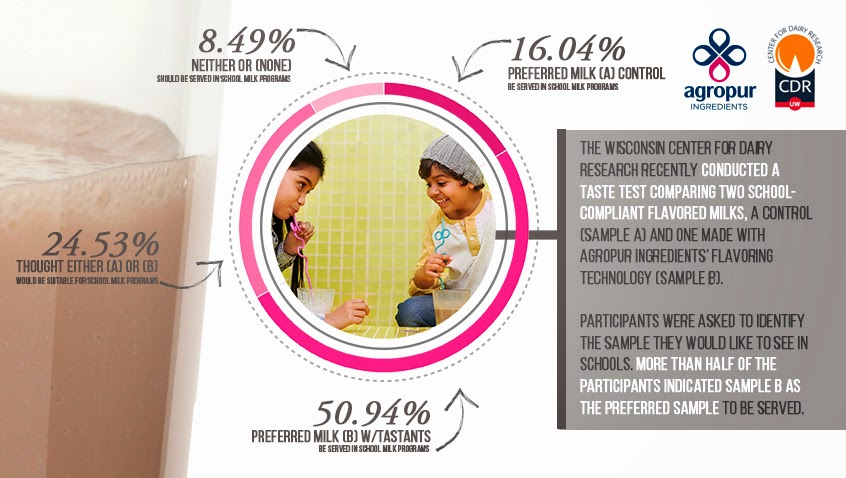
So, to make school flavored milk taste better, processors rely on various ingredient technologies. Recently, the Wisconsin Center For Dairy Research conducted a taste test comparing two school-compliant flavored milks, a control (sample A) and one made with Agropur Ingredients’ flavoring technology (sample B). Participants were asked to identify the sample they would like to see in schools. More than half of the participants indicated sample B as the preferred sample to be served.

There’s no denying it, sugar is on consumers’ radar. According to findings from the International Food Information Council (IFIC) Foundation’s 2014 Food and Health Survey, 51% of all Americans make an effort to avoid added sugars. Further, three out of five Americans consider sugars content in their foods and beverages to prevent health conditions and maintain a healthy weight. The least mentioned reason for considering sugars content is to help foods taste better, which suggests that consumers believe that a lower-sugar flavored milk can still taste great. That’s up to R&D.

Raise your glass to a better-tasting flavored milk for inside and outside the classroom! Cheers!

http://www.agropuringredients.com/our-brands/flavogen/

http://www.agropuringredients.com/our-brands/flavogen/


Friday, January 9, 2015

Cultured Dairy Products—Trends 2015

Happy New Year!

Over the holidays I had the chance to read The Big Fat Surprise: Why Butter, Meat & Cheese Belong in a Healthy Diet. In this New York Times-bestselling book, investigative journalist Nina Teicholz, who spent nine years researching the topic, upends the conventional wisdom about fats with the groundbreaking claim that more, not less, dietary fat--including saturated fat--is what leads to better health, wellness and fitness. Her research shows that natural fat is an essential part of a healthy diet.

This is something we have long known in the dairy industry. Not only is milkfat delicious and yes, nutritious (it’s a source of essential fatty acids, in particular conjugated linoleic acid), it’s also satiating, which means it ultimately helps one eat less and better manage their weight.

http://www.chr-hansen.com/products/product-areas/probiotic-cultures-for-food-beverages/campaigns/sogreek.html

Interestingly, this week, Josh Schonwald, a Chicago-based journalist and author of The Taste of Tomorrow: Dispatches from the Future of Food, identified “The Rise of Fat” as the number-one (of six) food trends for 2015. He cites commentary from Kara Nielsen, culinary director of the Sterling-Rice Group, who believes 2015 could be known as the year Americans get over their fat phobia, specifically natural, animal-derived fats.

Supporting these opinions is the Time magazine cover story from this past June entitled “Eat Butter.” The article explained that a growing body of research shows carbs, sugars and processed foods are mainly to blame for obesity, diabetes and other weight-related diseases, not fats.

It’s no wonder that the two biggest trends right now in cultured dairy products are full-fat and lower-sugar, sometimes together. Right after, which should be no surprise, is protein.

1)    Full-Fat Goodness
It’s a hat trick when you get all three, which is the case with Noosa Finest Yoghurt, which recently began offering its two most popular flavors—Blueberry and Tart Cherry--in four packs of 4-ounce cups. Each 4-ounce cup contains 140 calories, 5.5 grams of fat, 14 grams of sugar (including milk’s inherent sugar) and 7 grams of protein. The convenient on-the-go cups join the 8- and 16-ounce containers.

Noosa, described as Aussie-style yogurt, is made using fresh Colorado milk. Inspired by rich, thick Greek yogurts, Noosa is made at the family-owned Morning Fresh Dairy in Bellvue, Colorado. Noosa partners with Colorado-based Beyond the Hive to lightly sweeten its yogurt with golden Clover Alfalfa honey.

Such Aussie-style yogurt will likely be copied soon, as one private-label yogurt manufacturer was showcasing its own formulation at the Private Label show this past November.

Here’s an interesting spin on fat in yogurt. Though it’s low-fat and not milkfat, the emphasis is on the fat content. Barcelona-based specialty food company Casa Ametller recently introduced Yoligur, which uses olive oil to replace the saturated fats of milk. The company says this makes for a healthier product, with packages carrying a “0% animal fat” claim. There are five varieties: Apple, Pear and Cinnamon; Figs and Thyme; Original; Persimmon and Peach; and Pomegranate and Orange.

2)    Lower Sugar
Cultured dairy product formulators have many technologies available to assist with lowering added sugars. To read more, link HERE.


Using stevia, in combination with other natural sweeteners, is definitely the trend, as marketers want to keep formulations as simple and clean as possible.

At the forefront of formulating no-sugar-added yogurt is Sophie Greek Yogurt. Introduced a few years ago, and fine-tuned this past year, this was the only no-sugar-added Greek yogurt in the marketplace until this past week. This nonfat yogurt relies on a combination of all-natural xylitol and stevia, which results in a product with only 5 grams of naturally occurring sugar (from the milk) in each 5.3-ounce container. Depending on variety, there’s either 15 or 16 grams of protein. Varieties are: Banana Cream Pie, Blueberry Cobbler, Caramel, Chocolate, Strawberry Cream, Vanilla and Plain with Fiber. The latter uses oligofructose to provide 2.5 grams of fiber per serving.


Yoplait is introducing Yogurt & Juice Nonfat Beverage, which is sweetened with sugar and fructose, as well as monkfruit juice extract and stevia. The latter two help keep calories and added sugars low. An 8-ounce serving contains 110 to 120 calories and 19 to 22 grams of carbohydrates. Thanks to the addition of milk protein concentrate, a serving also provides 6 grams of protein. There are four flavors: Berry Pomegranate, Pineapple Mango, Strawberry, and Strawberry Banana.


3)    The Power of Protein
Speaking of protein, dairy needs to own this, after all “Powerful Proteins Come from Milk.” Read more HERE.

Dannon is all over the power of protein. This fall the company rolled out Dannon Light & Fit Protein Shake, which comes in four flavors: Banana, Mixed Berry, Strawberry and Vanilla. Sold in four packs of 10-fluid-ounce bottles, the nonfat yogurt drinks are enhanced with milk protein concentrate and polydextrose to provide 12 grams of protein and 5 grams of fiber, respectively, per bottle. Each bottle only contains 14 grams of sugar, including lactose, milk’s inherent sugar. Added sugars are kept low through the use of two high-intensity sweeteners: sucralose and acesulfame potassium. Added lactase also assists with keeping added sugars low. (More on this shortly.)

Just this week, Dannon introduced Oikos Triple Zero, a Greek yogurt with 15 grams of protein with zero added sugar, zero artificial sweeteners and zero fat. The product’s formulation, along with its marketing platform (the brand is the official yogurt of the National Football League), showcase Dannon’s continued efforts to engage a wider audience and expand its once predominantly female consumer base to include men.

Look for more information on this product this coming week as a featured Daily Dose of Dairy. But in a nutshell, by default, with fat at zero and no added sugars, protein content is increased. To sweeten the yogurt without adding sugar, the formulation relies on a variety of technologies, including stevia; chicory root fiber, which contributes sweetness while also delivering 6 grams of fiber per serving; and the lactase enzyme.

4)    Breaking Up Lactose
Yes, the lactase enzyme assists with sweetening, as well as breaking down lactose to make the yogurt more tummy friendly for those who are lactose intolerant.

To read more about “removing sugar while keeping the sweetness,” please link HERE to an article I recently wrote for Food Business News. It describes the science behind using lactase to assist with sweetening, as well as other sweetening tricks that are all ideal for cultured dairy product applications.

5)    Nothing Artificial
From sweetener selection, to flavors and colors, to stabilizing ingredients, dairy processors are wise to keep formulations as simple and as clean as possible. Proper culture selection can assist with removing label-unfriendly stabilizers from formulations.

Some brands are developing line extensions based on the simple and clean premise. For example, Kraft introduced a limited-edition Philadelphia cream cheese brick this holiday season that is crafted with only five ingredients. Special-Edition Baker’s Reserve Cream Cheese is made with pasteurized milk and cream, salt, carob bean gum and cheese culture. A 1-ounce serving contains 100 calories, 10 grams of fat and 2 grams of protein.

6)    The Pouch
WhiteWave Foods and Dannon are now both in the pouch yogurt business…but both with products once again targeting kids. This package is also an ideal format for high-protein cultured dairy snacks for on-the-go adults. There’s a great deal of opportunity for innovative products delivered via the pouch. Read “Appreciating Dairy Packaging; the Potential of the Pouch” HERE.

The new WhiteWave product is called Bonza and carries the trademarked tagline “one-handed” yogurt. The company filed for the trademark on June 9, 2014, and it was issued on December 23, 2014. What a nice Christmas present! There’s a lot of potential with the phrase and hopefully it will be used on yogurt products targeted to adults.

Bonza comes in 3.5-ounce pouches in four flavors: Blueberry, Orange, Strawberry and Watermelon. Each pouch contains 100 calories, 2 grams of fat and 5 grams of protein. Whey protein concentrate provides an extra boost of protein.

Packages tout the fact that the yogurt contains no artificial flavors or colors, is a good source of calcium and vitamin D, and contains live and active cultures. The latter is something missing in shelf-stable pouch yogurts. Individual pouches sell for about $1.29.


Dannon’s pouch is marketed under its Danimals brand and is called Squeezables. The low-fat yogurt comes in 4-ounce pouches in packs of four. The flavors have whimsical names. They are: Banana Cream, Blueberry Pie, Strawberry Banana Split and Strawberry Milkshake.

Like all Danimals products, Squeezables tout the fact that they do not contain high-fructose corn syrup or artificial colors and flavors. They also contain live and active cultures and are a good source of calcium and vitamin D. Each 4-ounce pouch contains 100 calories, 1.5 grams of fat and 4 grams of protein.


7)    New Formats
Yogurt is being used as an ingredient in all types of foods, including other dairy products. Greek yogurt, in particularly, with its higher protein content and thicker viscosity, renders itself as an excellent base for desserts, dips, dressings and spreads.


A&M Gourmet Foods has developed a unique spreadable yogurt that can be sold refrigerated or frozen. Sold under its Authentic Menu brand, and also available for private label, the spreadable yogurts comes in four flavors: Apple Cinnamon, Maple, Strawberry and Triple Berry. Made with Greek yogurt, fruit is the number-one ingredient. The product is intended to be spread on top of bagels or used as a topping on crepes, French toast, pancakes and waffles. The unique formulation allows the product to be merchandised in the freezer, right next to frozen breakfast foods, or in the refrigerated dairy or bagel case.


Last year at this time, Karoun Dairies livened up the spreads category with Blue Isle Mediterranean Yogurt Spreads. Similar in consistency to cream cheese, the spreads come in five varieties: Blueberry, French Onion, Honey, Original and Spicy Vegetable. A 2-tablespoon serving contains 60 to 70 calories, depending on variety, and 6 grams of fat and 1 gram of protein.  The spreads also contain probiotic cultures and are rich in calcium.


This coming week at the Winter Fancy Food Show, Karoun Dairies will introduce its new probiotic Blue Isle Yogurt Drink in Plain, Blueberry, Pomegranate and Strawberry.


General Mills will soon be rolling out Yoplait Greek 100 Whips. Aeration provides the yogurt with a lighter texture and mouthfeel as compared to Yoplait Greek 100. It also helps keep calories down, as air is calorie free. The nonnutritive sweeteners acesulfame potassium and sucralose also help keep calories down, as well as added sugars. Yoplait Greek 100 Whips come in the same 5.3-ounce container as Yoplait Greek 100, but the aeration yields a lighter product, weighing in at 4 ounces. Varieties are: Black Cherry, Blueberry, Lemon Meringue, Raspberry, Strawberry, Strawberry Cheesecake, Tropical and Vanilla Cupcake.

Stonyfield is now putting chia in its Greek yogurt. Greek and Chia comes in three varieties: Blood Orange, Blueberry and (mixed berry) Strawberry, Raspberry and Cranberry.

Why added chia? Well, it’s a source of alpha linoleic acid (ALA), an omega-3 fatty acid. Each 5.3-ounce cup delivers 500 milligrams of ALA. Each single-serve cup also provides 130 to 140 calories, depending on variety, and 1 gram of fat and 12 grams of protein. The chia contributes 1 gram of fiber per serving.

This past year, Chobani introduced Greek Yogurt Oats, which bridges the breakfast gap between yogurt and oats. This new breakfast-focused product is a blend of creamy Greek yogurt, with 10 grams of protein, 8 grams of whole grain and 3 grams of fiber from gluten-free steel-cut oats and real fruit. A 5.3-ounce cup contains 160 calories and is loaded with all-natural, flavorful ingredients including real fruit and maple syrup. It comes in four varieties: Apple Cinnamon, Banana Maple, Blueberry and Cranberry.


8)    Ethnic Flavors
The Millennial consumer wants to try new foods and flavors and this is driving ethnic fusion foods. Anything is possible.

Innolact in Spain offers innovative cream cheese spreads. Marketed under the new premium Quescrem Sabores Espanoles brand, the Queso-Crème Con line comes in three ethnic flavors: Algas (seaweed), Chorizo and Aceitunas (olives).


The Dean’s Dips line recently got heated up with some new spicy options that are bound to appeal to the millennial consumer, one of the biggest users of boldly flavored condiments such as refrigerated dairy-based dips. The two new offerings are Sriracha Spicy Thai Chili and Buffalo Ranch.

In early December, it was reported that Taiwan’s National Quemoy University’s Department of Food Science developed a yogurt beverage made of black garlic and milk. The beverage contains a much higher antioxidant content that promotes the prevention of cardiovascular diseases, according to the university.

9)    Dessert Style
This year we can expect to see more cultured dairy products positioned as healthy dessert options. A recent introduction that is bound to drive this trend comes from the Oikos brand. New Oikos Chocolate On Top and Oikos Caramel On Top are a new format of the popular high-protein yogurt. Each 5.3-ounce cup is Greek yogurt topped with a dollop of smooth creamy chocolate or caramel. The chocolate varieties are Raspberry Truffle and Chocolate-Covered Strawberry and the caramel offerings are Bananas Foster and Caramel Macchiato. Even with the extra layer of indulgence, the dairy snacks still pack in the protein, with each single-serve container providing 10 grams. A serving also contains 210 calories and 4.5 grams of fat.


German retailer Lidl now offers private-label Eridanous Greek-style Desserts, which start with a base of cream and yogurt, followed by a layer of fruit and liqueur (2%). There are three varieties: Dates and Orange Liqueur, Fig and Orange Liqueur, and Strawberries and Orange Liqueur. The single-serve chilled desserts come in 135-gram clear plastic containers. A serving contains 275 calories, 12 grams of fat and 3 grams of protein.

In the United Kingdom, Daffodil Foods now offers Luscious Layered Yogurts. These dessert-style yogurts are made with Welsh milk yogurt layered over fruity compote. Varieties are: Alphonso Mango & Passion Fruit, Fruity Raspberry, Senga Strawberry, Succulent Summer Berries, Timperley Rhubarb and Zesty Lemon. The yogurts do not contain any colorings, modified starches, glucose syrups, artificial sweeteners or artificial flavorings, so they are perfect as a healthier dessert option, according to the company. With a crystal clear unprinted pot, they look great on the dining room table. The pot allows consumers to see exactly what they are buying and eating.

France’s Marie Morin, a family-owned company specializing in dairy desserts, celebrated its 20th birthday this year. To commemorate, the company introduced a line of full-fat, dessert-style yogurts that are sold in 140-gram premium glass pots. The varieties are: Apricot, Blueberry, Hibiscus, Raspberry, Plain and Vanilla.

10)    Cottage Cheese---Really, the Time is Right
Cottage cheese has everything going for it in terms of composition. It is best tasting when it’s made with whole milk. It does not need to be sweetened. And it’s high in protein. What it needs is better marketing. Read more about the opportunities in cottage cheese HERE.

Once again, Happy New Year! Hope this blog provided some ideas for innovating.
http://www.chr-hansen.com/products/product-areas/probiotic-cultures-for-food-beverages/campaigns/sogreek.html


Thursday, December 18, 2014

Dairy Rules in 2015!

(Homemade all-butter shortbread….from my kitchen to yours...baked while blogging, and enjoying all the broken ones with a cold glass of 2% milk!)

From butter to yogurt, and all the amazing dairy foods in between, including cheese, cultured and milk, yes milk, 2015 may be a banner year for dairy foods sales…if you innovate and market well.

Dairy foods are being embraced by today’s consumers, in particular, Millennials. Dairy foods are recognized as inherently nutritious, clean label and naturally functional. Processors who keep formulated dairy foods simple and as close to resembling milk as possible, will find success in 2015 and for many years to come.

The past two weeks I’ve blogged about the importance of pasteurization. Keep doing it! An Australian subscriber sent me this news clipping on how raw milk processors are evading regulations by selling raw milk as “Bath Milk,” a cosmetic. Merchandised in refrigerators next to drinks, consumers are purchasing bath milk, drinking it and getting ill. Scary stuff! See the news item HERE.

In case you missed the power of pasteurization blog, you can read it HERE.

Dairy provides consumers permission to indulge
When discussing how dairy is enjoying a renaissance, New Nutrition Business recently reinforced a phrase I coined a few year back: permission to indulge. The author wrote, “Dairy’s image is getting a boost as science both refutes negatives around dairy fats and uncovers more about the positive effects of dairy consumption…U.S. butter sales have overtaken table spreads as people get ‘permission to indulge’ in more traditional dairy products.”

As I have stated numerous times this past year, milk’s positive nutrition credentials are driving sales of all types of dairy foods. And guess what? It’s not just the protein but also the fat, and not just the dairy fat in butter. It’s the milkfat in cheese, ice cream, cultured, whole milk yogurt and milk. The latest sales data from IRI Custom DMI Market Advantage Database shows that whole milk continues to display positive sales growth nationally (year-to-date, ending Nov. 2, 2014). See graph. 

Source: IRI Custom DMI Market Advantage Database, courtesy Midwest Dairy Association


This presents an opportunity to marry milk and cream with coffee, flavors, tea and beneficial ingredients and market the drink as a “made with real dairy” beverage.


A good example is a product featured this past October. From Ito En North America, Extra Rich Jay Street Coffee is creamier than the original fresh-brewed flavors, giving consumers the option to enjoy a rich and more robust coffee experience.

More recently, Upstate Farms rolled out Custard Shakes. This dairy beverage line comes in two decadent flavors: Chocolate and Vanilla.

(The shortbread are done. I’ve moved onto kolacky, also made with real butter, and better than any Polish bakery!)


Before I sign off for this year—the next Friday blog won’t be until January 9, 2015—please help me recognize the people and companies that keep your Daily Doses of Dairy coming.

For starters…thank YOU! It’s been another amazing year building BerryOnDairy.com and the Daily Dose of Dairy. Thanks to all loyal subscribers and a warm welcome to the newer ones! You are part of a rapidly growing (nearly 6,500 subscribers) global community of professionals involved in the development, production, distribution, marketing and merchandising of dairy products and related beverages.

BerryOnDairy.com and the Daily Dose of Dairy wants to help you sell more--and better--dairy foods. I welcome all comments—positive and constructive—nothing too harsh, I have two teenage boys who do a fine job of telling me everything I’m doing wrong. Feel free to send me an email HERE anytime. It was such feedback that led to the development of the Co-Packers/Product Development Assistance tab that you can access HERE.

This tab debuted in August at the same time I blogged about the benefits in using a co-packer. To read the blog, please link HERE. If you contact any of these companies, please be sure to tell them they were found on my website.

A special thanks goes to the many advertisers and blog sponsors that make BerryOnDairy and the Daily Dose of Dairy possible. Please make sure you thank these businesses. Please send an email to your sales rep and say “Happy Holidays! Thanks for supporting BerryOnDairy and the Daily Dose of Dairy.” To learn more about any of them, you can link to their websites by clicking on the company name.

Thanks goes to:


Have a Merry Berry Dairy Christmas and a Happy New Year!
With warm wishes, and a glass of cookies and milk,
Donna Berry (on Dairy)


www.BerryOnDairy.com


Thursday, December 11, 2014

Pasteurization, continued…and Dairy Show 2015

Photo source: Yoplait/General Mills

Last week’s blog on the power of pasteurization was the most tweeted blog I ever wrote. Thank you very much loyal Daily Dose of Dairy subscribers. The topic really resonated with many of you. If you missed the blog, you can link to it HERE.


The topic is very timely, as this week, the Centers for Disease Control and Prevention (CDC) published a study in its Emerging Infectious Diseases journal (January 2015) showing that the average annual number of outbreaks due to drinking raw (unpasteurized) milk more than quadrupled since the last similar study--from an average of three outbreaks per year from 1993 to 2006 to 13 per year from 2007 to 2012. Overall, there were 81 outbreaks in 26 states from 2007 to 2012. The outbreaks, which accounted for about 5% of all foodborne outbreaks with a known food source, sickened nearly 1,000 people and sent 73 to the hospital. More than 80% of the outbreaks occurred in states where selling raw milk was legal. You can access the review HERE.

www.dairyshow.com

According to CDC, as more states have allowed the legal sale of raw milk, there has been a rapid increase in the number of raw milk-associated outbreaks. Since 2004, eight additional states have begun allowing the sale of raw milk, bringing the number of states where raw milk sales are legal to 30. At least five additional states allow cow shares--a practice where people can pay a fee for a cow’s care in return for some of the cow’s raw milk--for a total of 10 states as of the most recent survey. If more states begin allowing sales of raw milk, the number of outbreaks and illnesses will continue to rise. CDC recommends against consuming raw milk, especially for people who may be more likely to suffer severe illness (children, senior citizens and people with weakened immune systems). More information about health risks associated with raw milk, link HERE.

With 2015 just weeks away, please add The International Dairy Show to your calendar. Make sure you budget for your travels.

This biennial event will take place September 15 to 18, 2015, at McCormick Place in Chicago—home of the Daily Dose of Dairy. And, back by popular demand, the Daily Dose of Dairy will be LIVE at the IDairyShow Theater located in the North Hall. During each day of the four-day expo, there will be a new products and trends presentation focusing on different dairy product categories. The schedule will be announced by early summer. Book your travels so you can attend all four Daily Dose of Dairy LIVE presentations. Each day is different.

As a Chicago native--my entire life, born and raised in the Windy City, not the suburbs, and still in the city proper raising a family—feel free to reach out with any hotel, restaurant and sightseeing questions by emailing me HERE.

Starting in the New Year, I will include a “must see” Chicago travel tip in every Friday blog.   
In addition to Daily Dose of Dairy LIVE returning, so is the Ingredients, Flavorings and Seasonings pavilion, as well as the Collegiate Dairy Products Evaluation Contest and IDFA Innovations Awards. And new in 2015, IDFA will feature two on-floor classrooms and has added the Distribution and Supply Chain Pavilion.

The show dates and hours are:
  • Tuesday, Sept. 15            9:00 a.m. to 5:00 p.m.
  • Wednesday, Sept. 16       9:00 a.m. to 5:00 p.m.
  • Thursday, Sept. 17          9:00 a.m. to 5:00 p.m.
  • Friday, Sept. 18               9:00 a.m. to 1:00 p.m.
The International Dairy Show 2015 is expected to be bigger and better than ever. Here are some pretty impressive numbers to help move you forward in the New Year.

100,000 to 10,000,000
Nearly a quarter of the attendees at the 2013 Dairy Show stated they will realize anywhere between $100,000 to $10 million in profits and cost savings directly from a solution they found at the Dairy Show. Imagine what you can do for your business by bringing your team and attending this event in 2015.

20,000
The Dairy Show is teaming up with Process Expo and InterBev—bringing the total attendance to 20,000 colleagues who you can network with.

1,000
Your Dairy Show registration gives you access to all three Shows where you can explore 1,000 suppliers offering the latest technology.

50
The Dairy Show is committed to making your experience the best you’ll have at any show throughout the year and to top the success of the 2013 Show—rated as one of Trade Show Executive Magazine’s top-50 fastest growing shows.


Less than one more month until registration opens! Check the Dairy Show website starting January 7, 2015. Make sure to earmark funds to cover the registration fees and travel for your entire team. Special discounts and benefits are available for groups.

For additional information on the show, link HERE.

www.dairyshow.com


Thursday, December 4, 2014

Pasteurization: It Cleans Up Our Milk Supply

Sometimes we forget why we do something that is part of routine, but when we don’t do it, the reason becomes very apparent--like forgetting to put on deodorant one summer morning. Proper pasteurization of milk is something a dairy processor can NEVER afford to forget.

Pasteurization makes our milk supply safe to drink because it makes it clean. Invented by French scientist Louis Pasteur during the 19th century, pasteurization involves heating milk to a specified temperature and holding it there for a predetermined amount of time in order to destroy all pathogenic (harmful) microorganisms, including E. coli 0157:H7, Campylobacter, Listeria and Salmonella. Pasteurization also reduces spoilage microorganisms, and by doing so, prolongs product shelf life.

http://bs.serving-sys.com/BurstingPipe/adServer.bs?cn=tf&c=20&mc=click&pli=11836394&PluID=0&ord=[timestamp]

With consumers demanding more information about their food, including their desire for clean labels and transparency in raw material sourcing, it is important that dairy processors communicate the reason why milk is pasteurized, and that is to make it CLEAN and SAFE. This includes the milk going into other dairy foods, such as cultured products, ice cream and yogurt.


According to a recent national survey, moms are actively reading food labels in search of nutritious, natural and safe foods for their families. (See graphs, courtesy of "Thought for Food" survey conducted by Chr. Hansen.)


To read a recent column I wrote for Food Business News online on raw material and ingredient traceability, which ties into food safety and clean label, link HERE.


The raw milk controversy
In my eyes, there is no raw milk controversy. Raw milk is unsafe. Final. Finish. Amen.

You would think that when Whole Foods Market stopped selling raw milk in early 2010, consumers would understand that the process of pasteurization does not turn milk into processed food, rather it turns it into food safe for human consumption.

(I am not going to spend much time on the topic of raw milk, but here are some resources in case you are curious.)

Attorney William Marler of the food safety law firm Marler Clark, Seattle, grew up on a farm, milking cows and consuming raw milk in the 1970s. Today when he hears the words raw milk, his mind is drawn to images of children sickened by consuming a product that their parents believed had properties that would be good for their child, not bring them to death’s door.

“I have represented several families of children who purchased raw milk directly from the farmer,” says Marler. “The children came away with E. coli O157:H7 bacteria-mediated Hemolytic Uremic Syndrome, months of hospitalization, hundreds of thousands of dollars in medical expenses and millions of dollars in risk of future complications, including end-stage renal disease and the need for multiple kidney transplants.”

You can access a PowerPoint presentation by Marler regarding the legal implications of selling raw milk by linking HERE.

Link HERE to read Marker’s blog on “Risky Business – Why would a retailer sell Raw Milk?”

For additional Raw Milk Facts, including information on states that allow the sale of raw milk, link HERE.

Promoting pasteurization
The idea of promoting pasteurization might sound strange at first, but then it makes sense when you realize you are letting consumers know that you have cleaned their milk of all dangerous microorganisms. It’s a perfect fit for the clean-label trend.

Check out what Whole Foods Market says about pasteurization and raw milk on its website by linking HERE.

There are two basic proven methods of pasteurization. The original, and most common, is referred to as HTST (high temperature/short time). This process involves heating raw milk to 161°F for at least 15 seconds. For a lengthier product shelf life, there’s UHT (ultra-high temperature) pasteurization. This process involves heating raw milk to 280°F for at least 2 seconds.

Interestingly, earlier this week, the Berkeley Wellness newsletter published by the University of California featured an article on low-temperature pasteurized milk. It can be accessed HERE.

The author describes the process as “vat” or “batch” pasteurization, and an acceptable way to pasteurize milk. The process involves heating raw milk in small batches to a lower temperature for a longer time (145°F for 30 minutes) and then rapidly cooling it. This process is said to better preserve the flavor of milk. This approach has become somewhat trendy as more small dairy processors try to appeal to shoppers seeking farm-fresh milk that is clean and safe.

A few weeks ago I made a dairy products innovation presentation to a group of dairy processors in Oregon, a state where farm sales of raw milk are legal, but not retail sales. These processors are real movers and shakers. Sunshine Dairy Foods impressed me with the story it tells on the side of its milk cartons regarding its pasteurization process, most notably, what it calls “Exp. Dates 101.”

This section reads: Don’t judge a milk by its “expiration” date. Sunshine milk isn’t hyper-cooked or over-processed, so it won’t have the latest date on the shelf—just the freshest flavor possible. Trust us, it’s a good trade-off.

This is an attribute that works well for the company’s distribution region. Of course, all pasteurization serves a purpose, and in some cases, this is to ensure safety and quality for longer periods of time, based on distribution and a market’s needs. Food deserts and food banks benefit from long-life milk products, including aseptically packaged milk, which is UHT-processed, packaged in a sterile environment and does not require refrigeration until opened.

Regardless of the pasteurization process your dairy employs, it makes sense to communicate to consumers why it is pasteurized. And again, that is to keep it clean and safe. Make it a point to talk about pasteurization to your consumers in 2015. Be transparent with them. They will be happy to know you have their back.

http://bs.serving-sys.com/BurstingPipe/adServer.bs?cn=tf&c=20&mc=click&pli=11836394&PluID=0&ord=[timestamp]